In Search of Sanford A.
Moeller in Connecticut
Tommy William Hanson, BA, N.A.R.D
Sanford 'Gus' Moeller ... is the main
subject of this article
[with related materials discovered during
a 2010 visit to New England]
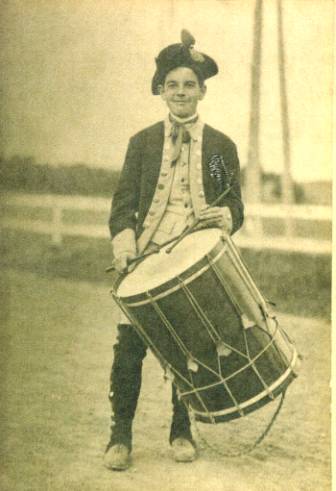
1938 American Legion National Champion Bob VonDeck. His style,
evident in the photograph, testifi es to his independence
from the regnant Sturtze method. VonDeck’s student Paul Cormier
says that VonDeck “talked about Moeller and Burns Moore all the time.”
Photo in author’s collection
JAMES CLARK
CLICK BELOW FOR
[ MOODUS
MUSTER - (2010) Photos ]
|
|
Background ...
April 10, 1928
W.F. LUDWIG EDITORIALIZES A CHALLENGE:
From the 1928 Ludwig Drum and Bugle Corps Spring
Bulletin ...
_________________________________________________________________
"The American Legion Drum Corps are not
so interested in rudiments"
"They are more or less marching drill
teams"
|
If
veteran’s organizations in the 1920s
and continuing on in the 1930s sponsored bands and corps that did not follow a
rudimental system of drumming (as a matter of course), then the time to do
something about it was certainly ripe. See again, the Ludwig quotes above
in red.
In order to combat this situation,
‘selling’ the idea that the country's American Legion and VFW organizations
needed to include competent rudimental drumming ... had to become more
aggressive.
The most famous American drummer to
harp on this subject at that time was the gifted author/drummer/drum maker ...
Sanford Augustus Moeller. Before Ludwig published Moeller's book, Moeller
had traveled around the country doing research. Those efforts finalized
with his compiling the collected material into a self-teaching manual ... "The
Art Of Snare Drumming."
BUT ... it should
be noted that there were a number of the New England states that were already
'well steeped' in a rudimental tradition during the 1920s (when Ludwig's
comments were made). New England, at that time (especially Connecticut),
was the home of a number of Fife and Drum Corps . The rudimental drummers
in those corps were certainly an active force, which represented world class
rudimental drumming in America during the 1920s (and certainly before the turn
of century). The rest of the country was really
not aware of this fact ... see later
about Dan English - an amazing Connecticut super star drummer.
The point Ludwig was
making in 1928 was valid
Back in the 1920s and 30s, it was
basically only those in the country who were connected with the military who
were fortunate enough to learn ‘the
knowledge’ .
With some exceptions, drummers who
were either in the military or who had taken instruction from military drummers
were the only fortunate ones who were shown drum rudiments as part of their
lessons. For example ...
J. Burns
Moore studied drum rudiments with a drummer in the Sarsfield Guards In
1888
That guardsman was - Jack Lynehan
~
J. Burns Moore went on to become the country's
most famous rudimental drummer for many years
Exceptions to the above statements
...
Excellent drumming skills came to
New England directly from Europe (the U.K., especially) by way of key
individuals
Of these key persons ... Samuel
Wilcox is perhaps the best known drummer/teacher of that time (from the early
1800s)
Hezekiah
Percival (the 'open stick' founder of the Moodus 'Ancients') learned his skills
from Wilcox
Other
organizations of note were the Mattatuck Drum Band and The Farmingbury Drum
Band
(The
Farmingbury Drum Band eventually became the Wolcott Drum
Band)
_________________________________________________
To continue ... regarding Ludwig's challenge and Moeller's contributions to
drumming
(1) The Moeller Book
(1925); (2) Moeller’s
march from New York City to Boston (1930); (3) The organization of
N.A.R.D. in 1933 ... were some of the important strategies at that time that
tried to help improve the over-all situation (regarding rudiments not always
being taught to young drummers) ... the exception being the north eastern states
(already mentioned above).
MOELLER'S MARCH
For the cause
of ‘bringing light’ to drumming and to a system of study based on
rudimental exercises … Moeller marched 248 miles over 10 days (averaging 25
miles per day) from Madison Square Garden (NY) to the armory in Boston
(Sept/Oct.
1930).
W.F. Ludwig
quipped:
"Moeller’s march to Boston was the
greatest stunt ever put over to
stimulate drumming and draw
attention to the study of drum rudiments."
At the end of this amazing feat,
Moeller discussed his journey with the press (and other interested individuals
in Boston). He pointed out that drummers should be aware that learning
rudiments and 'working-out' with drum rudiments should be considered the highest
form of drumming (as far as he was concerned).
After his historic march, Moeller
reported that he used (what he called) ‘the correct holding of the
sticks’. He did this while on his historic journey (beating his drum
‘every step of the way’). Moeller emphasized the fact that at the end his
10-day march, he did not have a blister or a callous on his
fingers!
Moeller was basically saying … this is the correct way to play a
drum if one has to do so all day long. It is the most natural and the most
ergonomically correct way to hold the sticks ... and to move the wrists, arms
and shoulders in order to beat a drum with strength (and to have endurance while
doing so). This advice is also
the definition of what a civil war drummer was taught in order to master the
grueling job of rendering (daily) all of the drum beats needed to maneuver the
troops ... i.e., 'The Army's Camp Duty'
.
OF COURSE, THIS ADVICE WAS ONLY
FOR THOSE DRUMMERS
WHO WERE SLINGING A DRUM
SITUATED AT A GOOD ANGLE
(AS THE 'ANCIENTS' DID)
~
As said above, there was an ignorant kind of mind-set relative to most
drummers in the country at that time! Learning drum rudiments was not that
popular in the 1920s (outside of New England). This was probably because
of the rise in popularity of the drum set. But those who have read
Moeller's book carefully ... know that he did recognized more than one
kind of drumming.
Moeller was definitely aware that
the little finger grip was only appropriate for parade or field drumming
situations ... that is, 'open style drumming'
(used by the 'ancients').
Moeller was well aware that the
grips he used 'on the march' would be inappropriate for playing a drum set or an
orchestra roll on a concert snare. His book points out this concept on
page 11.
So ... when he made
the statement ... "The correct holding of the sticks" ... what he was saying
pertained to parade drumming or field drumming only. The statement
pertained to playing a drum being slung at an angle. It pertained to those
drummers who rendered 'open style
drumming' ...
playing rudiments
using the 'standard and
authentic' grips.
HOW VISIBLE IS MOELLER IN
CONNECTICUT TODAY ?
|
To begin to respond to
the above
To begin to respond to the above
question ... here is a newspaper item taken from the New England Register
(1930).
(paraphrased)
Friend to Sanford Moeller, Daniel
English, of the Lancraft Fifers and Drummers Organization, sent Sanford
Moeller a pair of drumsticks that he will be using on his march from New
York city to Boston. |
|
Moeller was made a member of the Lancraft Corps
while on a visit to New Haven several years ago.
His membership took place when he was on a
25,000-mile research trip around the country.
During that time he gathered material for his
self-teaching drum manual.
William F Ludwig (of the famous drum company)
published Moeller's book back in
1925. |
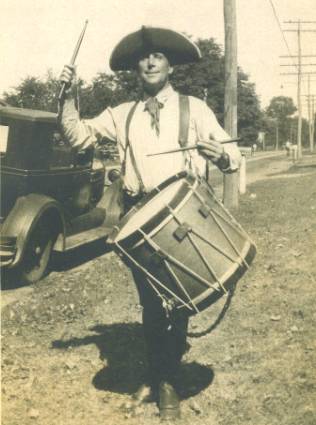
The above photo was taken by James
English at the 'crossroads' (September, 1930) in New Haven, CT
Moeller was Drum Sergeant in the
7th Regiment (New York National Guard) at that time
~
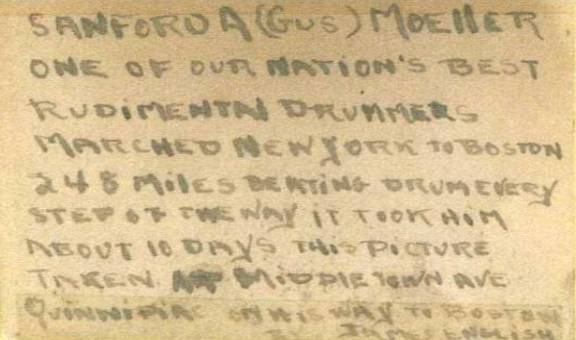
|
SANFORD A (GUS) MOELLER
- ONE OF OUR NATION'S BEST RUDIMENTAL DRUMMERS MARCHED NEW YORK TO BOSTON
248 MILES BEATING DRUM EVERY STEP OF THE WAY - IT TOOK HIM ABOUT 10 DAYS -
THIS PICTURE TAKEN AT MIDDLETOWN AVE QUINNIPIAC ON HIS WAY TO BOSTON
BY JAMES ENGLISH |
|
__________________________________________________________________________________
TO ADDRESS THE QUESTION AS TO HOW VISIBLE MOELLER IS
TODAY IN CONNECTICUT ... THE SHORT ANSWER IS THAT HE IS REMEMBERED MORE FOR HIS
DRUM BUILDING AND NOT SO MUCH FOR HIS DRUM LESSONS (OR PLAYING STYLE). FOR
EXAMPLE ...
On August 8, 1954, Moeller personally delivered five
new snare drums that were purchased by the Lancraft Fife and Drum Corps for
$85.00 each. Those Moeller drums are still being played today. Additional
drums were purchased through the years from; Buck Soistman, Bill Reamer and his
son, Andrew Reamer (drums that were patterned after the original Moeller drum
forms).
~
|
NOW-A-DAYS THERE ARE ONLY A HANDFUL OF CORPS
THAT FOLLOW WHAT MOELLER STOOD FOR ... LEARNING/PLAYING THE SNARE
DRUM AS IT WAS TAUGHT IN THE PAST. MOELLER'S PARTICULAR
INFLUENCE CAME FROM COUNTLESS NUMBERS OF CIVIL WAR DRUMMERS WHEN HE
VISITED WITH THEM IN THEIR RETIREMENT HOMES.
THAT INFLUENCE (THE 'CIVIL WAR' DRUMMING STYLE) WAS WHAT
DAN ENGLISH EXHIBITED WHEN MOELLER SAW HIM FOR THE FIRST TIME. DAN
WAS A FAVORITE BURNS MOORE STUDENT. MOORE HAD LEARNED THE MILITARY
STYLE JUST AS MOELLER DID. THIS TRADITION MADE IT POSSIBLE FOR DAN
TO SCORE HIGHER THAN THE AMAZING EARL STURTZE MORE OFTEN THAN NOT DURING
THE 1920s.
AFTER THE 1920s, STUDYING THE STURTZE 'CONTEST
METHOD' BASICALLY BECAME THE NORM. HE INNOVATED AN ORIGINAL
APPROACH FOR CONTEST DRUMMING THAT WAS FOLLOWED BY THE MAJORITY OF SOLO
SNARE DRUMMERS AFTER THE DEATH OF DAN ENGLISH IN 1931. BUT IT SHOULD
BE KEPT IN MIND THAT THE STURTZE STYLE IS ACTUALLY QUITE STRENUOUS FOR
DRUMMERS TO EXECUTE (DUE TO THE HIGH UP AND DOWN STICKING USED IN
CONJUNCTION WITH HEAVY DOWN STROKES).
THE STURTZE (CONTEST) STYLE, THEREFORE, WOULD NOT HAVE
BEEN SUITABLE TO MARCH 20-25 MILES A DAY ... AS MOELLER DID WHEN HE MADE
HIS FAMOUS MARCH FROM NEW YORK CITY TO BOSTON. AS STATED EARLIER,
RECALL THAT THE MOORE/ MOELLER/ ENGLISH APPROACH
REPRESENTED A VINTAGE STYLE FROM THE PAST. WHEN INTERVIEWED IN
BOSTON, MOELLER WAS PROUD TO SAY THAT WRIST ROTATION AND A LOOSE RIGHT
HAND GRIP MADE IT POSSIBLE FOR HIM TO PLAY FOR LONG PERIODS OF TIME
WITHOUT FATIGUE OR BLISTERS. IN OTHER WORDS, STURTZE WAS MORE
SPRINTER-LIKE ... WHILE MOELLER WAS LONG DISTANCE! |
|
MOELLER'S LETTERS TO DAN
ENGLISH
3986 44th Street - Long Island
City, NY
(Sanford Moeller's New York address as it looks
today (2010)

Printed below are excerpts from letters written to Dan English by
'Gus' Moeller
There were several letters spanning
the years from 1928 to 1930. The excerpts are shown in red
(following). The documents were given to the Lancraft Fife and Drum
Corps library by James English (Daniel's brother). James was a Lancraft
fifer and an extremely important person in the scheme of things. He was a
fifer who won competitions ... just as his brother did.
It was James English who made it
possible to be able to document his brother Dan's relationship to the Lancraft
Corps and his brother's personal relationship with Moeller. Recall the
photograph that he took of Moeller (at the crossroads) ... shown earlier
(above).
Moeller’s own words (below),
clearly show a high regard for Dan and his abilities
Moeller's letters reveal a sincere
respect for Dan's talent ... and his deep respect for Dan English as a
person
Dan English Was A
Perfect Drummer - As Far As Moeller Was Concerned
|
'Danny' (as
Moeller called him) represented the classic 'ancient' approach. Dan
won all of his trophies using that 'old school' style.
BUT ... he was
merely following his lessons with Burns Moore. That is, the style
that Dan learned came from the military tradition ... going back to the
revolutionary war. More later. |
|
3986 - 44th St. Long
Island City, N.Y.
Dear Friend
Danny;
… of course you
must have received first place [at Naugatuck], but I haven’t yet heard how the
different prizes were awarded … your drumming is excellent.
May I say that
no matter how long one may have to wait during competitions, they would be fully
well repaid when they finally hear you. I am most anxious to have a good
long session with you and talk drumming and show you all I have to show. I
am sure I have the best library of drum instructors in existence. I have
them in many different languages and I have many of the most interesting and
valuable of the old books published in this country.
Then there is so
much to say about drum corps in general and the condition of drumming.
Also, I would like to talk to you about judging drumming contests. As I
have said, I have had long sessions with drummers from most all the big cities
in the country. It’s the way I learned to drum. How many pleasant
afternoons I have spent with Harry Simms, the old drummer of the U.S. Marine
band and now retired. Sometimes Bill Keefer, who is now first drummer with
the band, would drop in…
This is a P.S.
As
you will see I wrote this letter and it got mislaid and not mailed and I found
it today. Well I wanted to ask you for a picture of yourself anyway.
I want a picture of [someone re-enacting] a Colonial drummer for a
trademark.
It would certainly be
nice to have a champion [like yourself] to pose for the model and you have just
the physique I want and everything. I am going to ask you if you would
just have a snap shot taken and send it to me. I don't know just what pose
I would want. I would like a straight front view with the sticks in
position as if you were flaming and perhaps a pose just standing still.
Now could you send me a couple like this; just a little brownie camera would
work. I'll make it up to you.
____________________________________________
3986 - 44th Street
Long Island City N.Y. (September 11th 1930)
Moeller wishes to use drumsticks that he
wanted Dan to provide him for his solo march to Boston
Dear Friend Danny;
Now I want to ask you
about getting a nice pair of sticks like you use. I would like to pick a
pair to suit me for they probably vary a little but I suppose that any pair you
said was good would be alright.
However, write me some
of the dope about the sticks as I want to get a pair or two and maybe
more. I hope you will be able to do this right away and if you are too
busy perhaps your brother [James] could do it.
I hope you are
enjoying the best of health and that I will see you before a great while.
I am going to try and do a lot of drum corps coaching this winter and I will
write you about it soon and will probably have to ask you for information in
regard to success in that line.
I had the honor of
being a Judge at the Convention of the American Legion at Saratoga last
Friday. I worked with Philip Egner, 1st Lieutenant, U.S. Military Academy,
West Point NY. I have known him for a long time but had not seen him for
about nine years. I must see you and tell you all the news.
[ Philip Egner was
the composer of West Point's official West Point March ]
____________________________________________________________
(November 11th
1930)
Dear Friend
Danny:
I am most anxious to
take a drive over the route I traveled on foot [last Sept/Oct]. I’m
anxious to renew the acquaintance of the wonderful people I met when I made
the trip. Amongst the pleasant memories of the trip was my brief stop in
your home … and the wonderful courtesies you showed me.
(Moeller, of course,
is referring to the solo march that he made from NYC to Boston a couple of
months earlier)
There is a man in east
Hampton who showed me a fine old drum and he is also a fine drummer and leader
of the East Hampton Drum Corps. He makes his own heads and they are the
finest I have ever seen and he said he would show me how it is done if I come
over and spend the time, which I am certainly going to do. They are purely
raw hides and they are not thick and they will stand such a hard blow as you
would not think possible.
I feel that it
will be the biggest moment in my life when I get up to tell the old Lancraft
corps, the Lancraft fraternity and in no other place than that old headquarters
... about the man with the spirit who marched for the love of it from New York
to Boston. I left the World Radio Fair at Madison Square Garden, NY about
noon on the 24th of September and arrived at the Armory of the First Corps of
Cadets in Boston at 2.30 October 5th.
As I said before
I sort of hope it will be a cold wintry evening like the one when you had the
'old timers' get-together. I walked
all over that section with a gallon under my arm and I remember slipping around
in the snow. I do love those winter
evenings and it was so cozy inside your old cabin.
I will never
cease to regret that something happened to rob me of that great honor of having
the Lancraft Corps escort me through the city. Our failure to make
connections brought something to my ears in Boston that is going to interest you
when you hear it and I am going to save it to tell you.
I sent your
sticks back [with] Burns as you probably know by this time. They were most
valuable to me and it was extremely lucky that our comrade discovered that mine
were cracked.
The Lord be
praised ...to get a man like Burns Moore to teach the way to drum. Very
few realize what fine work Moore is doing for the welfare and I can say for the
preservation of drumming.
Now this work is
not known throughout the country as it should be. You folks around Conn
and Mass know it of course but west of there they are without the means of
knowing what great work is being carried on in New Haven.
Will close with
best wishes for all the boys and high hopes for their continued success and
happiness in the clean American sport of drumming, which they love so
dearly.
Respectfully
yours,
SA
Moeller
The above letters were provided
by ...
George Meinsen (former president and current historian of the
Lancraft Fife and Drum Corps)
[ More excerpts
from Moeller's letters will be included in a 'part
two version' of this article in the
near future ]
If history shows that “Gus” and “Danny” were
friends...
WHY?
- HOW DID THAT COME ABOUT?
~
The answer no doubt begins with
New Haven's J. Burns Moore and Moore’s second teacher, Jack
Lynehan
______________________________________________
Moeller, at some point in
time, became aware that New England (Connecticut) had produced a superstar ...
Dan English. Dan's reputation probably came to his attention when Moeller
traveled on his 25,000 mile excursion through the country - consulting with the
locals in each state that he visited (to always include the retired army
drummers from the civil war era who were still living in the various
'old soldier retirement' homes).
Dan English was
considered by many in Connecticut (in the 1920s) to be the most talented drummer
of all rudimental drummers in the North East … and perhaps in the whole country
for that matter.
BUT few knew about
Dan’s talents (as one traveled westward)!
~
Because of Dan's exemplary
dedication ... and because of the encouragement of Burns Moore (early on)
... Dan English won the following championships before passing away at the early
age of 28 years.
Daniel English (a Lancraft corps
member from New Haven) won the U.S. National Championship in 1923 - he won the
World Open Championship in 1925
Dan won the Connecticut state
snare drumming title in 1920, continuing in 1925, '27 and '29.
He won the world title at Naugatuck
in 1928. And before he became terminally ill, resulting from heart
disease, he won the North East States Title ... and the U.S. National
Championship in New York in 1930.
~
Dan's success (see the above
championships that he won) undoubtedly caught Moeller’s attention because of
Dan's style. Dan's drumming approach motivated Moeller to want to
cultivate a sincere relationship with him.
The most
important reason that Moeller respected and supported Dan was the fact that he
was keeping an ‘ancient tradition’ alive and winning contests with
that
‘old school’ approach ... it was the drumming style of the
'ancients' that he learned from Burns Moore (similar right hand grip, angled
drum, etc.). Dan's drumming approach was akin to Burns Moore and to Sanford
Moeller. It was a drumming style that followed the military tradition
since early America (the American Revolution etc.). Pictures contained
later in this article will show this to be the case.
~
Recall that Burns
Moore (Dan's influential teacher) also won contests while rendering the
'ancient' style. It was a drumming approach that was passed down from the
18th and 19th centuries. Dan played a drum the way a drum was always
played by drummers slinging a deep drum (at an angle) prior to the
1930s.
BUT as history has
shown ... within a few years after Moeller’s book was published (and after the
passing of Dan English) ... winning contests with the 'old school' style was no
longer possible.
After Moeller's book
was printed, things began to change in the world of ‘rudimental
drumming'.
MOELLER'S STYLE OF
DRUMMING
Sanford Moeller’s drumming style (what he wrote about in his book) ...
was obviously meant to be a vintage drummer's 'how
to' manual. It was a
self-teaching instruction book that showed how a deep drum was normally played
in the past. That is, the book concentrated on how a drum was played
(mastered) before the twentieth century. Moeller called the drum lessons
in his book ... the 'standard and authentic'
rudimental drumming method
that was inherited from the
past. It was the method that was handed down through the military
since the American Revolution.
In a word ...
Moeller's book contains lessons as to how a deep drum was proficiently played,
circa 1860
This drumming style
was what most American drummers learned - living in the 18th and 19th
centuries. It was the accepted 'school of drumming' at the beginning of
the 1900s (but did not continue as the drumming style of choice past the
1930s). The 'jazz age' and various rudimental drum teachers (influenced by
Earl Sturtze) changed all that.
Eric Perrilloux "all the top drummers were Sturtze drummers." "They had
speed and power in their rolls and could go a notch higher and faster than
anyone else". Perrilloux was originally a
drummer in the Charles T. Kirk drum and bugle corps (as well as in many other
famous corps in later years).
Jack Tencza (Lancraft): "Sturtze would pinch the stick - he
would grip the [right] stick harder than
the 'ancients'.
(see Mazur's The
Perfectionists)
Lessons In
Moeller's Book (and the style of ‘the ancients’)
Might Very Well Be
Considered One And The Same !
~
Moeller's book did not contain training tips to help win twentieth
century solo contests! Moeller knew that! Winning trophies in
solo competitions was not the purpose for compiling and writing his book!
Moeller only wished to show the history of drumming ... the method that was
handed down from the past (the 'ancient
style').
In the 1920s, fewer
and fewer drummers cared about the history of drumming or cared about the old
and noble rudimental drumming traditions. It was becoming clear that speed
(playing rudiments faster) was the 'new' goal among the next generation.
The rudimental tempos of the past (at or less than 110-112 bpm), began to sound
too old fashioned to the 'new ears'
of the young.
As said earlier, the
reason for this development was probably because of the fact that the next
generation of drummers were more interested in jazz (they were growing up at the
beginning of the 'jazz age'). There was an increasing interest to follow
the popular dance band drummers who flourished in the 1930s and 1940s.
Showing speed (fireworks) was the new goal ... and not the traditional
('ancient') way of playing.
Accented single
stroking and paradiddle combinations ruled the drum set world. A dance
band drummer needed just a few rudiments in order to 'wow' the
public.
~
As for rudimental contest drumming
... rendering breakdowns (at a faster tempo)
began to appeal to the rudimental solo drummers (and naturally to the judges
eventually). If a drummer (after the 1920s) could take a breakdown to a
faster speed than their competitors ... judges, more often than not, began to
give them the edge. The 'old' tempos and playing styles were
fading.
A 'new' generation of
drummers began to dominate the annual solo competitions. Those drummers
started to place ahead of drummers who were following Moore, Moeller, Dan
English, etc. In other words, former champions (who kept
'the older traditional
style', alive) were becoming less relevant. Corps began to
'modernize'.
MORE ON
MOELLER
Moeller is an historical figure who is not understood all that well
(today). To many, he was a drummer who held on to an old fashioned style
that nobody wanted to follow once the 'jazz age' got a foothold. But
wasn't Moeller doing exactly what corps, such as, the Moodus 'Ancients' want to accomplish?
To reiterate once
again ... Moeller wanted to write a book that would show the standard and authentic way to beat a drum (circa
the 1860s).
Moeller's book should
be thought of as being historical ... his writings were not meant to be
contemporary or innovative.
At the time when his book was being printed,
the traditional drum angle, traditional stick grips and so forth started to be
put aside. A more scientific and stream-lined drumming approach started to
evolve ... an approach that was more competitive for solo playing (i.e., playing
the breakdowns 'a notch faster').
BUT ... that was not without
consequences: Corps drumlines began to 'look' different! Compare the
photos of Dan English and William ('Big') Reamer (coming up below) ... to see
the differences.
~
Moeller passionately taught his 'Moeller lessons' to anyone who would
listen. He advocated learning the technical skills associated with the old
school drumming approach during the initial stages of learning to
drum.
The 'correct' style
needed to be learned in order to authentically play a vintage 'deep drum' (as
was done in the previous century). This task should be mastered first,
according to Moeller, before a drummer specialized elsewhere. This was his
point of view. It was how a 'complete' drummer should be
trained.
Moeller's idea was
that a drummer should be competent enough to play the Army's Camp Duty before
specializing to play the drum set or specializing to cover percussion parts in a
theater orchestra (and so on). This point of view was definitely the very
reason for the way he put his book together!
~
'Gus' Moeller was not a narrow man by any means! Recall that he was the
influential teacher of two twentieth century drum set giants ... Gene Krupa and
Jim Chapin.
If a drummer in the 1920s and early
1930s wished to concentrate on jazz, theater work, symphonic employment or even
dance band drumming ... Moeller's lessons (his book) wasn't a bad place to begin
(to create a solid snare drumming foundation). And that foundation was to
(first) learn the rudiments of drumming ... and to then go on to master playing
a snare drum using 2-grips.
It's important to
never forget that Moeller's book emphasizes learning a 2-Grips
approach:
(1.) Practice rudiments using the rudimental grip for the right
hand ... [little finger
fulcrum]
(2.) Practice the
jazz/concert approach using a different right hand grip -
[the thumb pinch grip]
Grip #2 above was necessary to produce a good
sounding 'pressed' roll (buzzing the sticks to create a 'closed
roll')
Defining what a drummer
is...
It's interesting to note that the definition of
the word drummer began to change after the second decade of the twentieth
century. The word drummer at the beginning of the 1920s started to mean
(more and more) ... someone who played a set of drums! This was not true
when the 20th century began.
As the twentieth
century moved forward ... the word 'drummer' ceased to be associated with the
image of the 'colonial drummer' ... that is, a colonial drummer playing an
'open' style approach using rudiments on a slanted, 'deep'
drum.
By the time the 1920s
ended ... traditional drumming (as Moeller knew it) was basically gone and
forgotten. The public's point of view regarding the word
drummer was more
associated with names like Gene Krupa ... and not so much associated with names
like J Burns Moore, Moeller, Dan English and so forth!
J. BURNS
MOORE
|
"The Lord be
praised ...to get a man like Burns Moore to teach the way to drum.
Very few realize what fine work Moore is doing for the welfare and can say
for the preservation of drumming" . . . . . Sanford A Moeller (1930) |
|
J. Burns Moore developed a solid
rudimental foundation by practicing drum rudiments that were shown to him when
he studied with a drummer who was a member of the Sarsfield Guards in New Haven
CT. That drummer was Jack Lynehan. Jack later moved to New
York.
Lynehan understood the military
(civil war) style of drumming because his knowledge also came from the
military. He was able to pass on that expertise to Burns Moore while Moore
was still a young man. He was more than willing to learn all he could
about how those guard drummers could drum so well. Through Moore, a high
degree of rudimental expertise was passed on to Dan English. He eventually
became a Lancraft drummer and a drum sergeant. English won a number of
contests back in he 1920s before his early death in 1931.
~
J Burns Moore (in the early stages
of his career) was chiefly known as a championship rudimental snare
drummer. He won top honors in a number of drum contests - and retired from
them all undefeated. Moreover, he was the first president of the N.A.R.D.
organization (est.1933). and held that position for more than two decades.
Not every drummer knows this, but Burns Moore should also be respected for his
skills as a percussionist. For over 45 years, Moore was the timpanist for
the New Haven Symphony Orchestra.
In a letter to Dan English in
1930, Moeller praised Moore for producing excellent drummers in and around
New Haven, CT. However, during the 1020s, this fact was basically unknown
to the rest of America. Therefore, one can't help but conclude that when
Moore was winning contests, he did so with a drumming style that was much like
Moeller. They both supported an approach that was similar to the style of
the military drummers from the previous century. Moore was the older of
the two but was lesser-known than Moeller to drummers outside of New England.
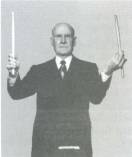
See photo (below), where Moore shows
that he is obviously using the little finger right-hand grip ('ancient'
style). Unfortunately, this has been erroneously dubbed, 'The
Moeller Grip' over the years.
Moeller recognized
Moore because of the 'standard and authentic' vintage approach that Moore
learned from Jack Lynehan. It was that 'civil war' style that he used to
render the rudiments during Dan English's lessons. He was definitely
teaching 'old school' before the Sturtze contest style became the
norm.
Student, Dan English,
went on to capture a number of contests using the military style that he learned
from Burns Moore.
Notice the right hand 'little
finger grip' - Emphasized in Moeller's book
|
 J. Burns
Moore J. Burns
Moore
At some point in time, after
retiring from competing in solo competitions, Moore made a conscience
decision to break from the 'ancient' style that he had learned as a boy
and moved toward the Sturtze contest style that was overtaking
young Connecticut drummers after 1930. Obviously he saw the Sturtze
innovations as a drumming approach that was replacing the military 'look'
inherited from the previous century. The new interest was
'speed'.
But when one thinks about it, increasing
speed (playing rudiments) should have no baring on fife and drum corps
that march to the older (slower) tempos
In the end, and as history
shows, Moore's snare drum book, The Art of Drumming (1937),
eventually contained photos in the 1954 reprint. Ludwig included
it in the Ludwig Masters series. The reprint definitely shows an
Earl Sturtze influence. In other words, the book's pictures
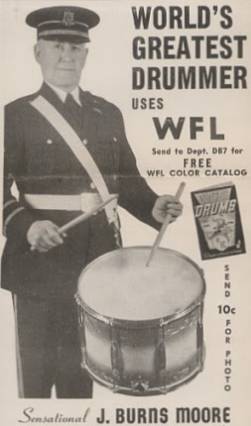
(published in the '50s) do not look like the photo shown above ("The
World's Greatest Drummer" -see photo left to compare to photo
above).
Notice also that there is a
"flat practice pad" in the photo left. The orientation of the
pad definitely infers that at the time of the re-printing of his book, the
traditional grip on a level drum was going to be the future! This
inference turned out to be correct. However, and ironically so, the
Sturtze 'contest style' was overtaken by the matched grip revolution
(making his instruction book - The Sturtze Drum Instructor) less
relevant to the majority of drummers who have studied rudimental snare
drumming after the 1960s). This notion - that the Sturtze system was
only popular to the 1960s) has been put forward before by David De
Lancey:
"The traditional "Sturtze" style of drumming ... is
fading from use in many Ancient Corps"
In contrast to Moore,
Moeller did not break from the
civil war drumming style and stood up for keeping
that drumming approach alive his entire life
( First learn to drum as the
'ancients' did. Then specialize in drum set, concert snare drumming,
pipe drumming etc. - after the old style has been mastered )
|
WHAT HAVE WE LEARNED?
STUDYING THE MOELLER
BOOK' IS NOT A RECIPE FOR SPEED OR FOR WINNING CONTESTS
MOELLER'S BOOK WAS A
RECIPE FOR LEARNING THE ANCIENT (TRADITIONAL) STYLE OF
DRUMMING
THE 'CAMP DUTY
REPERTOIRE' (IN HIS BOOK)
WAS MOELLER'S BENCHMARK
~
[ Again - Moeller's concept was
that the rudiments - using the ancient right hand grip - should be mastered
first as part of Moeller's 2-grips approach ]
The statements
below are just conjecture (but they probably ring
true regarding the majority of drummers who were looking for
direction)
The
young drummers of the 1930s - the next generation of drummers after Moeller's
book was published probably thought about things as follows:
"I can play faster than those old
military drumming types." "I play jazz on a set of drums AND I also play
in an 'ancient' fife and drum corps." "And as far as my playing is
concerned, why bother with learning two different grips when one grip
(thumb-pinch) can do both. And who needs all of those rudiments when many
of them (the ratamaque, for instance) can't be played that fast." "They
can't be used on fast dance tunes."
"Rudiments are OK when you're
first learning the drum set, but you can't speed some of them up enough to be
useful." "We should just forget about those old drummers and how they
played!" "I'm not going to follow that 'old style' that my teacher wants
me to learn first" ... "That guy Moeller, for example, is too
old-fashioned."
~
Moeller had to face criticism during the latter
part of his life for being a drummer who was 'out of touch'. He became (in
many minds) a drummer who couldn't win solo competitions anymore with his out of
date playing style.
What most do not
realize about Moeller is that when they saw him play ... they were literally
looking at a drummer who was reenacting an early American drumming style (circa
- mid 19th Century). That style dominated up to and including the
1920s. It's interesting to note that Moeller never gave up demonstrating
the style of the 'ancients' and never edited his book to do a revised printing
as Moore apparently did. Moore's 1954 edition is definitely
different from his first book (published in 1937).
So who was
Moeller to many Connecticut drummers in 2010?
"Oh, he built
drums, right?" "Also, his playing style became too old fashioned to be
relevant (competitive) "
Most drummers who answered this
author's 2010 questionnaire responded that they were in the habit of using the
same right hand grip to play everything (for all
occasions).
MOELLER'S
QUESTION: HOW CAN THE
SAME GRIP PLAY BOTH AN OPEN DOUBLE STROKE ROLL - AND A
CLOSED ROLL (Buzzing The Sticks) ?
His concept (remember) was ... Different
muscles are involved when comparing the ancient and modern
style
Therefore (according to
Moeller) a 2-Grips policy
should be considered the better way
to learn
~
REVIEW
Moeller, himself,
can be seen pictured in his book - sitting at a snare drum using 'that second
grip'... a different grip from what was shown on page 4 in his book.
On page 11, Moeller
demonstrates an adjusted position for playing a concert snare drum. That
is, the picture shows a drummer's posture for playing a concert snare drum
(where a closed-roll grip is called for ... for 'delicate shadings' ). He is showing the thumb-pinch
fulcrum.
He is suggesting that
the above mentioned fulcrum (for the right hand) is best for the orchestra roll
and for drum set drumming. To say again, Moeller agreed that a grip change
was necessary for the purpose of rendering a drummer's closed roll (an orchestra
roll). He never suggested that
drummers should use the back of the hand (little finger grip) for
everything. Below is a quote from his book regarding the little finger
grip...
"This shift of
position is most noticeable in the right hand and permits a more delicate
shading" [ page
11]
THE RUDIMENTAL STYLE
(Ancient and Modern)
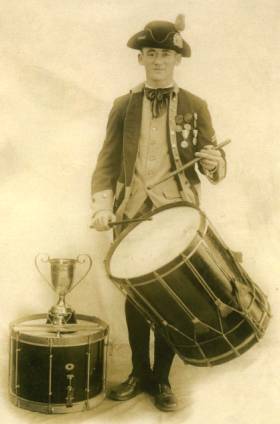
LANCRAFT DRUMMERS ... GEORGE GALLAGHER* (left) - DAN ENGLISH**
(center) - SHOW THE 'ANCIENT STYLE' (pre
1930s)
WILLIAM 'BIG' REAMER*** (right) - DEMONSTRATES A MORE MODERN
DRUMMING APPROACH INNOVATED BY EARL S. STURTZE
~
*
George Gallagher ['Drummer
Boy'] - Lancraft State Champion
(Connecticut) ... 1911, 1912, 13,14, 15
It should be noted that Gallagher competed against the state's seniors when he
won his snare drumming titles
**
Dan English -
Lancraft Drum Sergeant and State Champion (Connecticut) ...1920,
'25, '27 and '29
*** Bill Reamer - Showing the 'Post-Moeller' approach ... 'The High
Connecticut Style' * Up and Down
Sticking - Use of Heavy Accents - A More Level Drum
* The 'High Connecticut Style' (associated
with Earl S. Sturtze) was brought to Pennsylvania by Bill Reamer. It was
Reamer who coached the McCall Bluebirds (1947) to win the American Legion Junior
Championship. His drumlines used 'the Post-Moeller'
approach. That is to say, his drumlines were influenced by the 'newer'
Connecticut sound (Consult Ken Mazur's "The
Perfectionists").
__________________________________________
Analyzing
the two photographs on the left (circa pre 1930) will show that Lancraft
drummers, Gallagher and English, exhibit a relaxed posture - as per the
'civil war style'
This can be seen especially in their
relaxed shoulders. The 'ancient' posture was to hang down the right arm
considerably. Drums were slung so that the arm was not bent very much at
the elbow (contrast this with the third photo). The civil war drummer
would strike the drum thus: The wrist and forearm rotated out and in
rather than being lifted up and down.
GEORGE GALLAGHER
DAN
ENGLISH
BILL REAMER
It's unfortunate
that George Gallagher (photo above - left) died quite young at the age of
21 years
And it is
extremely sad (as well) that Dan English followed later with an early death at
the age of 28 years in 1931
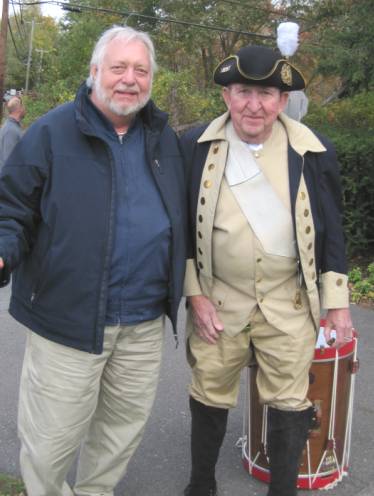
Below, is a
picture showing this article's author with Jack McGuire - the heart and soul of
Lancraft's drumline ... Today (2010)
Jack, as a
boy, was a member of the St. Francis School Drum Corps and went on to become a
well respected Sturtze student
Tommy William
Hanson Jack
McGuire
TO SUM UP ... MOELLER'S
BOOK
As stated in Moeller's
writings, the US Army recognized a particular and specific snare drumming
approach that existed when Moeller's book was first published (1925). His
book's lessons were 'compiled' (not invented or innovated). The
'authentic' information in Moeller's writings evolved from the recognized and
accepted drumming manuals from the 18th & 19th century (the playing
approach of the 'ancients').
So why criticize
Moeller for trying to keep the past alive for future drummers to study and
consider?
~
THE FOLLOWING ARE SUMMARY STATEMENTS - ( SOME COMMENTS ARE REPEATED FROM WHAT HAS
ALREADY BEEN WRITTEN ABOVE )
The drum tutors that
were officially recognized by the US military dealt with how to play a drum
proficiently ... so as to master the army's camp duty. This is what stimulated Moeller to write his book.
The finishing touches to Moeller's research came from the civil war drummer boys
(themselves) when Moeller personally interviewed them (as 'old' soldiers) in
their various retirement homes. No doubt he 'bonded' with those 'old
timers' during each visit.
For the purpose of
uniformity, vintage military drummers all learned how to drum from certain
approved manuals. But more importantly ... referring to them fulfilled a
continuation of the patriotic past. Moeller was definitely an American
patriot and certainly represented a very old drumming tradition ... the accepted
military style since the American Revolution (circa, 1776). And that
meant, for example, using the 'back of the hand grip for the right
stick'.
When one studies
Moeller, it's clear that he loved the old military drumming tradition that he
learned about in detail (first hand) from the civil war drummers. But
above all, we should also be aware that Moeller (himself) was an active-duty
soldier (Spanish-American War) as well as a reservist. These facts should
easily set Moeller apart from many of the other well-known rudimental drummers
of the early 20th Century.
This article does not
cover Col. Hart's contributions, as his approach to drumming was
different. He did not follow the Bruce/Strube approach as did the Moore
(early on), English and Moeller. This not to say that different is
bad. Basically, he only differed as to how he taught the right hand
grip.
NATIONAL ASSOCIATION OF
RUDIMENTAL DRUMMERS
After many
discussions ... George B. Bruce and Gardiner A. Strube were adopted to be the
rudimental authorities by the founding members of N.A.R.D. back in
1933.
A telling credit to Moeller's
contribution to the art of drumming (and why he should be appreciated as one of
the giants of the past) is the fact that in 1925, when Moeller's book was
published, he cited George B. Bruce and Gardiner A. Strube as the drumming
authorities that should govern rudimental drumming in America.
Recall that his book preceded N.A.R.D.
by eight years ... and that organization came to the same
conclusion. To say again ... that conclusion was cited in Moeller's book
eight years earlier. Moeller also called for J. Burns Moore to be the
model to follow for the rudimental drumming in Connecticut.
~
The
MOELLER BOOK SHOULD BE THOUGHT OF AS HISTORY
He was basically
saying:
'ATTEND TO HOW IT WAS
DONE IN THE PAST'
But to remind the reader yet
again ... corps following Hart or the Wilcox school of drumming should also be
thought of as corps following an 'ancient' style (even though not recognized
by the US military). Consult the Moodus Drum and Fife Corps for
more information.
FINAL
OBSERVATIONS:
It
is true that Moeller's style would be out of
place regarding the DCI drum corps circuit, today. But so would the
drumming style of Burns Moore, Dan English and Earl S. Sturtze for that
matter.
However, we should
recognize that each era in American history has played its part in the country's
development and should be studied, documented and remembered. This article
is advocating that ...
Moeller Was
Advancing An Historical Connection ........ (the 20th century with the
past)
It's just too easy
to say:
'Oh, that out dated
stuff ... no one plays a drum anymore the way Moeller did'
~
BUT ... to subscribe
to the above philosophy would also mean that we should eliminate all graphics of
the American flag when it only had 13 stars and 13 stripes ... because 'Old
Glory' went on to expand from there (and today's America doesn't use that flag
anymore).
'That early American flag is in
the past, now ... so we should just forget about it!'
The above view would
actually advocate deleting parts of history as time goes along ... and
it's a bad point of view. Why, for example, don't we see two flags carried
by F&D corps when they march in parades as 'ancient' corps? The second
flag could be proudly carried in memory of the original colonies (13 stars and
13 stripes)! The Lancraft F&D
Corps, for example, many times feature the Betsy Ross and Grand Union flags when
performing. Also, one member of their color guard may at times appear in a
first nation's American Indian costume (when possible).
MOELLER'S BOOK IS
HISTORY
Should we just move on and forget
about how 'ancient drummers' actually played ?
Should we just say that ...
Moeller's playing style and his book are simply too old to be
useful?
Shouldn't we continue to emphasize
that the 'ancient' drumming techniques can still live today!
~
This article has attempted to put Sanford
Moeller in a better light than what's been the case for many
decades
Moeller's mission was to keep the
'ancient style' alive ... especially within the Fife and Drum
Community
But his mission will fail unless some of us
try harder to be more authentic (regarding the past)
...
END NOTES
*Many thanks to George Meinsen (former president and current
historian for the Lancraft Fife and Drum Corps)
*A considerable amount of reference material in this article
came from information located in the Lancraft archives
*Many references are from Ken Mazur's 'The
Perfectionists' - (An invaluable document to the history
of drumming)
*Thanks also to 'Jim Clark' and his generosity - CVFM ...
(Connecticut's Fife and Drum Tradition - PhD James Clark,
Author)
*And thanks as well to those drummers who agreed to filling out a
short questionnaire:
| Cliff
Barrows - Connecticut Blues | Danny O'Mara &
Jack McGuire - Lancraft
Fife and Drum
Corps |
| Marty Bryan and
Jim Enos - Kentish Guards |
Unfortunately, other
corps contacted were not able to accommodate this author's research visit - Fall
(2010)
NOTABLES WHO
HAVE COMMENTED ON THIS
ARTICLE:
| |
"A really good
read" |
Rick
Beckham - The Rudimental Drummer
|
| |
"Some interesting
history here" |
Geoff
Brown - Bayonne Bridgemen Snareline
'84 |
|
"Thank you
for the really amazing article on Moeller and his connections to CT drum
corps" |
Charles
Book - CT
Hurricanes |
* The following Web Sites were important for
their historical/background information:
HERE ... FOR MORE
SANFORD MOELLER ARTICLES BY THIS AUTHOR